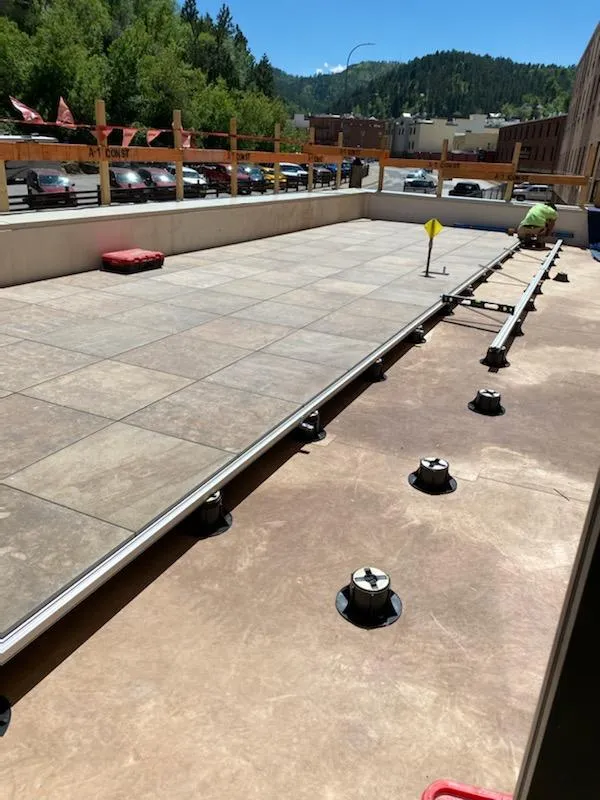
What Is the Best Rooftop Decking System?
What Is the Best Rooftop Decking System?
April 13, 2026
Rooftop decks are one of the most demanding applications in construction. They sit directly over conditioned space, are fully exposed to the elements, and must meet strict structural, drainage, fire, and wind uplift requirements.
So when asking “What is the best rooftop decking system?”, the real question is:
What system performs reliably over decades without failure, maintenance cycles, or structural risk?
The Reality: Most Rooftop Decking Systems Are Not Engineered Systems
Concrete Pavers on Pedestals (Industry Standard)
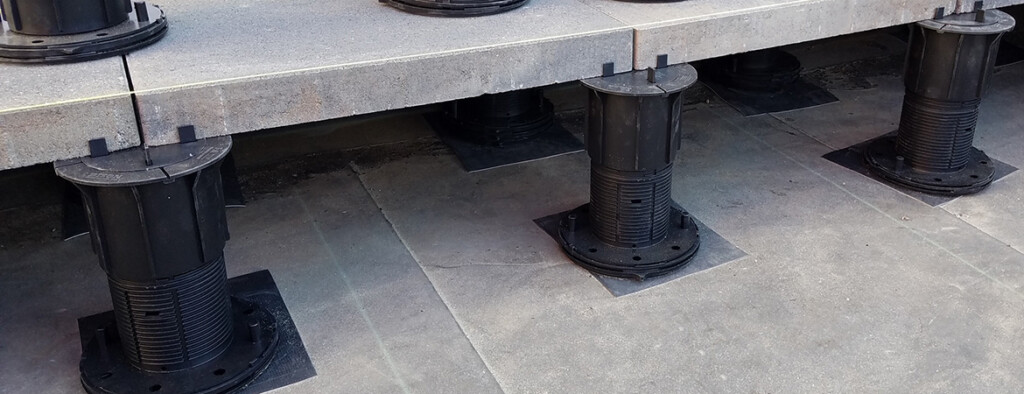
What they are:
Loose-laid concrete pavers supported by plastic pedestals at each corner.
Why they’re popular:
- Fast install
- Easy access to roof membrane
- Widely specified
Where they fail:
- No mechanical attachment
- Movement and wobble under load
- Vulnerable to wind uplift
- Uneven load distribution
- Long-term instability as substrates shift
- No reinforcement for load bearing
- Susceptible to mildew and mold
- Easy to stain
- Limited aesthetic
- Very heavy (30-40 lbs per square foot)
Bottom line:
Pedestal systems are not true structural systems. They are floating surfaces.
Wood & Composite Decking on Sleepers
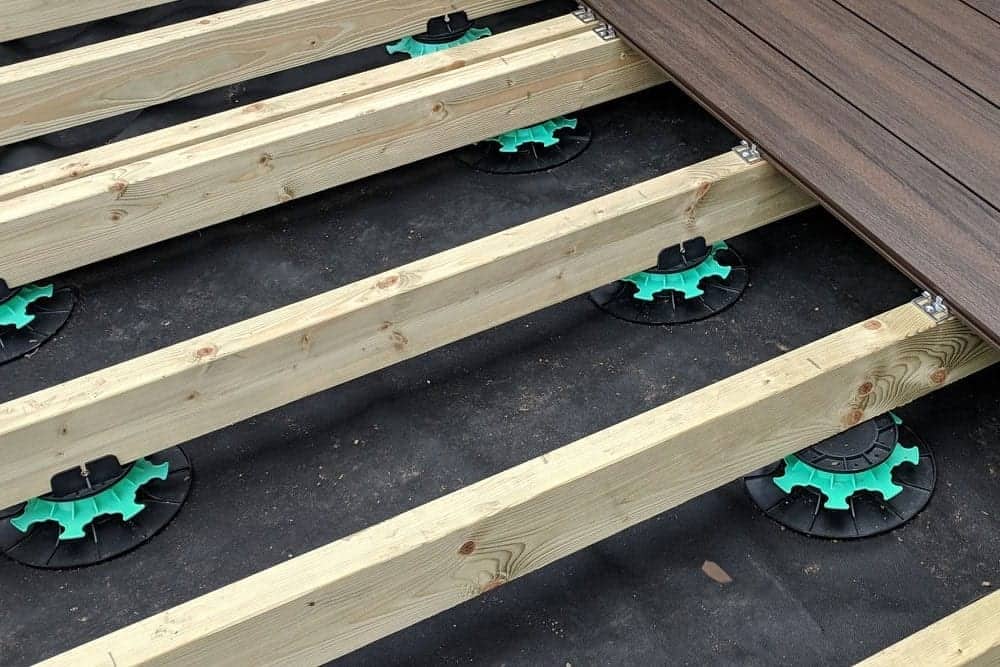
What they are:
Traditional decking installed over sleepers placed on the roof.
Why they’re popular:
- Familiar installation method
- Lower upfront cost
Where they fail:
- Organic materials degrade (rot, mold, UV breakdown)
- Composite boards expand, contract, and fade
- Trapped moisture risks roof membrane damage
- High maintenance cycles (sandind, sanding, replacement)
Bottom line:
These systems are not designed for rooftop environments.
Porcelain Pavers (Loose-Laid)
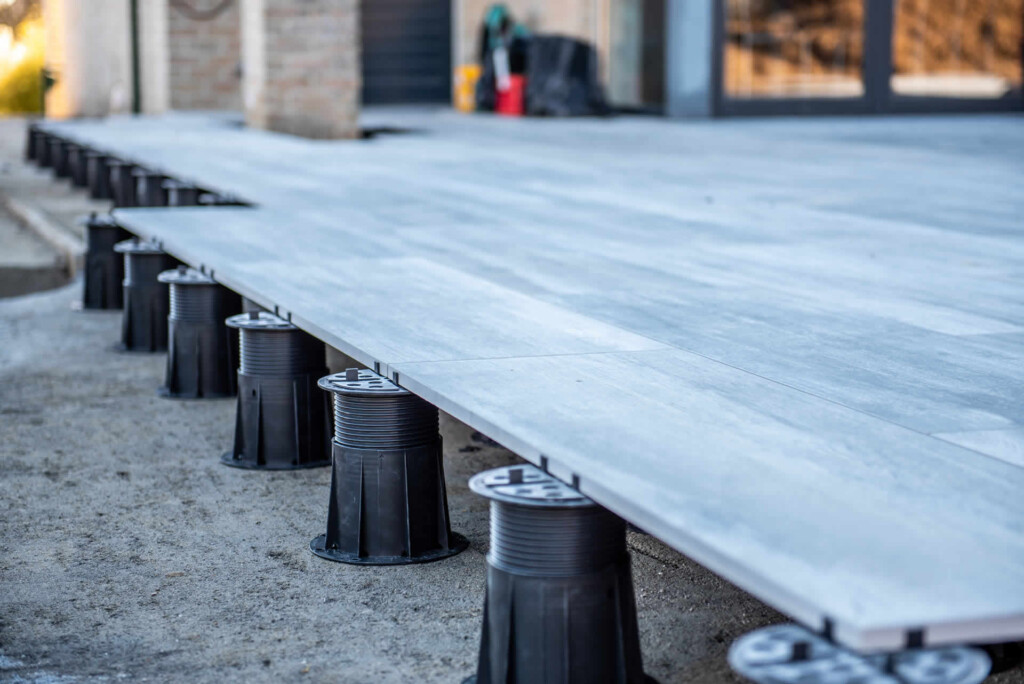
What they are:
Porcelain tiles placed on pedestals or sand-set systems.
Why they’re attractive:
- Modern aesthetic
- Durable surface material
Where they fail:
- Still rely on pedestal system limitations
- No lateral restraint or system integration
- Brittle under point loads when unsupported
- Not engineered as a unified assembly
Bottom line:
The material is strong, but the system is weak.
What the Best Rooftop Decking System Actually Requires
To perform long-term on a rooftop, a decking system must be:
- Mechanically fastened (not floating)
- Structurally stable (no movement or deflection)
- Load-distributing (not point-loaded corners)
- Wind uplift rated (engineered and tested)
- Free-draining (protects roof membrane)
- Non-porous and freeze-thaw resistant
- Low or zero maintenance over decades
Anything less introduces risk.
The Engineered Alternative: Integrated Porcelain Deck Systems
Fully Integrated Porcelain Systems from Mbrico
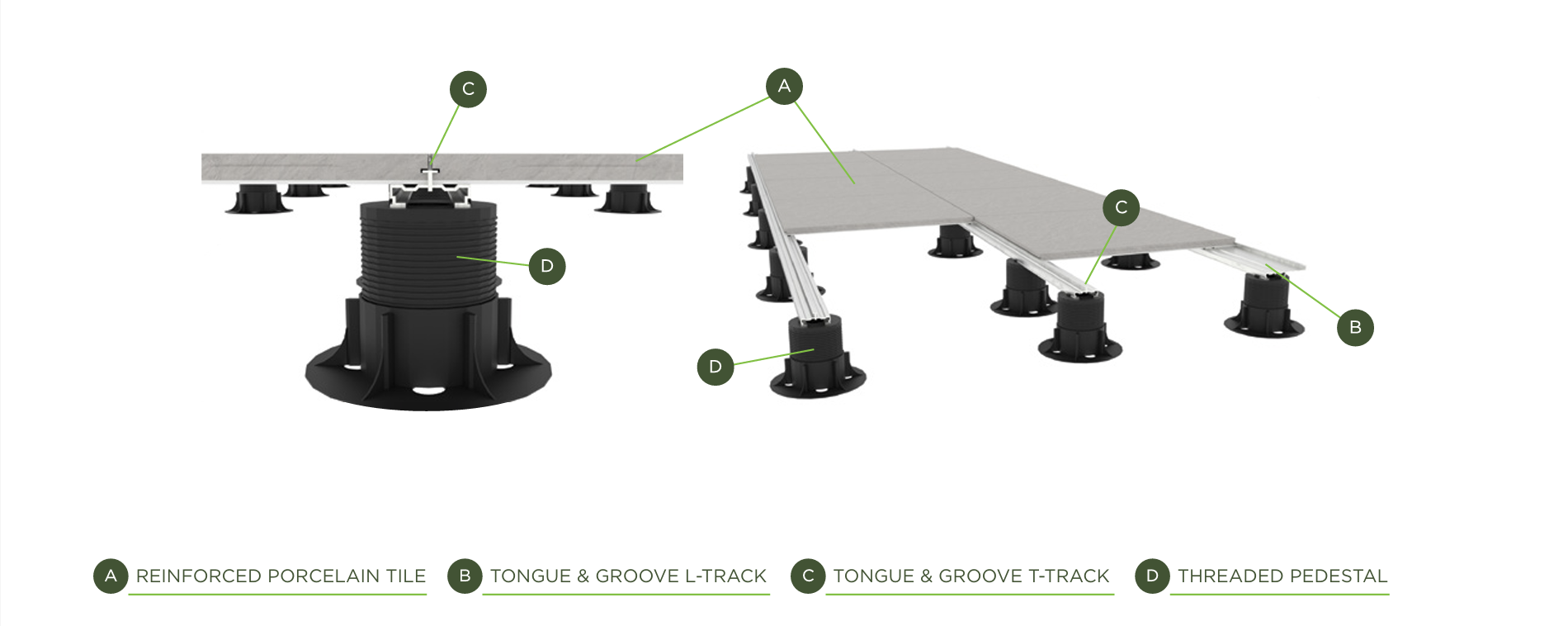
What makes this different:
Instead of placing tiles on top of a support system…
The tile IS the system.
Key performance advantages:
- Mechanical fastening
Each tile is secured into an integrated tongue and groove track system. No movement. No shift. No wobbling. - Zero wobble structural stability
Load is distributed across the entire system, not just corners. - Engineered wind uplift resistance
Tested systems (including Miami-Dade compliant assemblies) resist extreme conditions. - True system integration
Surface + structure + spacing + drainage work as one assembly. - Porcelain performance
- Non-porous
- Freeze-thaw resistant
- High slip resistance (DCOF)
- No fading, warping, or degradation
- Long-term lifecycle advantage
No sanding. No staining. No replacement cycles.
Final Answer: What Is the Best Rooftop Decking System?
The best rooftop decking system is not defined by the surface material alone.
It is defined by whether the product is a true engineered system.
The top-performing solution today is:
A mechanically fastened, fully integrated porcelain decking system that eliminates movement, distributes load evenly, and is engineered for rooftop conditions.
Everything else is a compromise between speed, cost, and long-term risk.
Key Takeaway for Architects, Builders, and Developers
If you are designing or specifying a rooftop deck:
- Avoid floating systems
- Avoid organic or movement-prone materials
- Prioritize engineered assemblies with verified performance data
Because rooftop failures are not surface-level issues.
They are system failures.

Contact Us