How Mbrico Solved the Elevated Pool Deck Challenge for Two New Jersey Waterfront Clubs
How Mbrico Solved the Elevated Pool Deck Challenge for Two New Jersey Waterfront Clubs
August 21, 2026
Elevated pool decks create a difficult material problem.
The structure needs to perform like a deck. The surface needs to perform like a commercial pool environment. In coastal flood zones, the entire assembly may also need to sit several feet above grade.
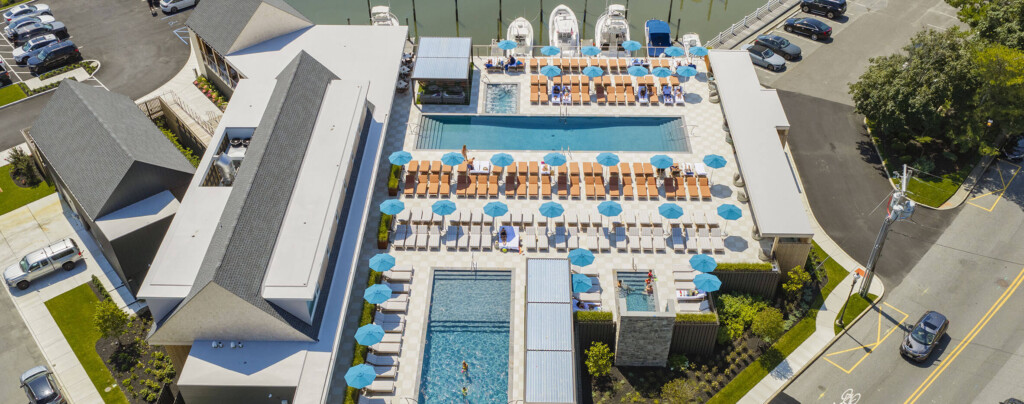
That was the challenge facing Parnagian Architects and Scarborough Properties at two New Jersey waterfront developments: Brigantine Marina & Paddle Club and Somers Point Paddle Club.
The solution was an elevated timber-framed structure finished with the Mbrico reinforced porcelain decking system.
After using Mbrico at Brigantine, the project team specified the system again at Somers Point on a pool deck approximately four times larger.
The Challenge: Porcelain Over an Elevated Deck
Parnagian Architects works extensively throughout New Jersey’s coastal waterfront zones, including barrier islands, bayfront properties, and flood zones.
Those conditions frequently require occupied spaces to be elevated well above grade.
At Brigantine Marina & Paddle Club, the exterior pool deck and bar area needed to be elevated. The design team wanted to keep the underlying construction relatively simple and efficient.
Instead of building a more complex roof deck assembly with multiple waterproofing, drainage, and perimeter components, the team designed the structure much like a traditional elevated pressure-treated timber deck.
That created the next question:
How do you put a porcelain surface over conventional elevated deck framing?
Wood decking was considered, including Ipe. Around a pool, however, the client had concerns about bare feet and potential splintering.
Scarborough Properties wanted a porcelain or stone surface.
That search led the project team to Mbrico.
Why Mbrico Was Different
Mbrico gave the team a way to combine traditional deck construction with an engineered porcelain surface.
The reinforced porcelain pavers integrate with an aluminum track system installed over the supporting structure. Narrow joints allow water to drain through the walking surface while the system mechanically secures the pavers in place.
For architect Brian Parnagian, the primary advantage was the system itself.
“It’s like an elegant basic solution.”
He described the key differentiator as the systemization of an open-joint porcelain surface that could integrate with traditional timber-frame construction.
That distinction allowed the project team to achieve the appearance and performance of porcelain without treating the area like a conventional pedestal roof deck.
Designed to Integrate With the Building
Large deck surfaces are rarely the most difficult part of an exterior assembly.
The details happen at the edges.
Pool coping. Building thresholds. Fascia conditions. Waterproof transitions. Changes between enclosed and exterior spaces.
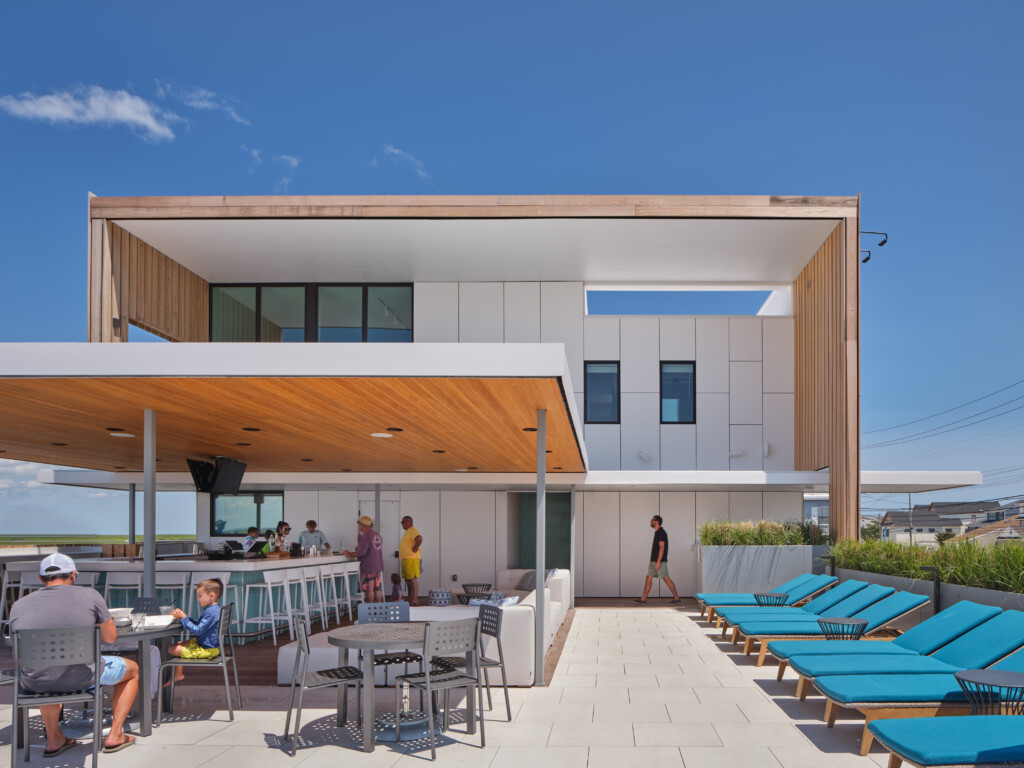
Both New Jersey projects included complex transitions between elevated open-joint deck areas and enclosed portions of the buildings.
According to Parnagian, Mbrico was straightforward to incorporate into those conditions.
“It just integrates very well and is easy to detail around.”
Once the architectural team established the total depth from the top of the framing to the finished porcelain surface, they could coordinate the surrounding elevations and details.
Mbrico’s technical literature, DWG details, PDF details, and direct technical support helped the team work through the assembly.
Parnagian described the process as “straightforward.”
From Detail to Installation
A system also needs to work in the field.
The crews on these projects installed a significant amount of Mbrico decking.
There were specific perimeter and edge conditions to learn, but once installers understood the system and completed the first several courses, the installation became repetitive.
“Once they trained their guys on a few courses, then they were able to just deploy that all the way through.”
That repeatability became even more important on the next project.
Brigantine Proved the System. Somers Point Scaled It.
Brigantine was the project team’s first application of Mbrico.
Somers Point was different.
The architects, developer, and project team already understood how the system worked.
According to Parnagian:
“We were all on the same page going into that. This is how it’s going to go.”
The basic approach remained the same.
Elevated timber framing below.
Mbrico reinforced porcelain decking above.
Only the scale changed.
Parnagian estimates the Somers Point pool deck is approximately four times larger than Brigantine, possibly more.
That repeat specification matters.
Mbrico was not simply selected for a single unusual application. The system performed well enough for the same project team to use it again on a substantially larger waterfront pool deck.
Why Porcelain Works Around Elevated Pools
Pool decks place several demands on an exterior surface at the same time.
For these projects, the design team considered factors including:
- Slip resistance
- Freeze-thaw exposure
- Coastal conditions
- Drainage
- Surface temperature
- Elevated structural conditions
- Joint spacing
- Long-term stability
- Architectural appearance
Porcelain gave the team another option beyond conventional wood decking and concrete surfaces.
It also gave the architects more control over the finished design.
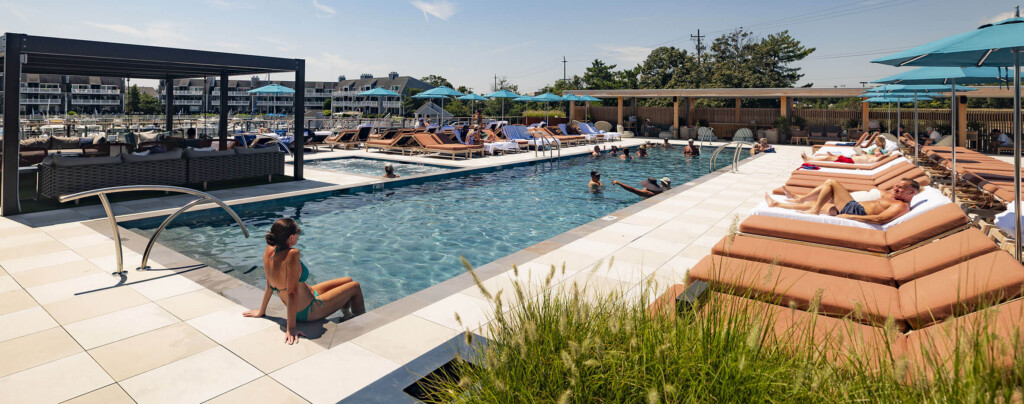
At Somers Point, two similar neutral porcelain colors were installed in a subtle pattern across the large pool deck.
The result remained quiet and architectural rather than creating a high-contrast checkerboard appearance.
Parnagian’s assessment:
“It came out nice.”
How Does an Elevated Porcelain Deck Feel?
One of the immediate questions surrounding any elevated porcelain system is how it feels underfoot.
Parnagian has walked both completed projects.
His description was simple:
“It feels solid.”
That is an important part of what separates Mbrico from porcelain used only as a finish material.
The paver, reinforcement, aluminum track, attachment method, and supporting structure work together as a decking system.
A Project-Specific Code Advantage at Somers Point
Somers Point also presented a unique code consideration.
The project team needed to address the potential for debris to pass through the elevated deck and accumulate below the structure.
Because of the tight joint configuration of the Mbrico system, the design team was able to present the installed condition to project inspectors and the authority having jurisdiction.
According to Parnagian, the configuration was accepted for that specific project as sufficiently restricting debris from passing through the deck.
This was a project-specific determination, not a universal code condition.
It does, however, demonstrate the importance of treating an elevated deck as a complete system rather than selecting the surface material in isolation.
Would the Architect Specify Mbrico Again?
He already did.
After Brigantine, Mbrico was specified again at Somers Point.
When asked directly whether he would recommend Mbrico to another architect considering a similar application, Parnagian responded:
“Yeah, absolutely.”
He also identified Mbrico’s porcelain stair treads, nosings, and risers as an application he would like to incorporate into a future project.
That system allows designers to carry the porcelain surface from the deck onto traditionally framed exterior stairs.
A Different Approach to Elevated Pool Decks
Brigantine and Somers Point started with a relatively simple question:
How do you build an elevated deck and finish it in porcelain?
Mbrico provided the answer.
Traditional framing below.
An engineered aluminum track system above.
Reinforced porcelain at the surface.
Open drainage through the deck.
One integrated system.
The first project proved the approach.
The second project scaled it.
For elevated pool decks, waterfront properties, balconies, amenity decks, and other demanding exterior applications, Mbrico provides another way to build.
The future of decking is porcelain.
Contact Us