Can You Put Porcelain Tile on a Wood Deck? What Has to Change Structurally
Can You Put Porcelain Tile on a Wood Deck? What Has to Change Structurally
September 14, 2026
Porcelain is commonly associated with concrete patios, interior floors and other rigid surfaces. That leads to an understandable question for homeowners and builders considering a different type of outdoor deck:
Can you put porcelain tile on a wood deck?
Yes, but the answer depends heavily on how the porcelain is supported.
Traditional porcelain tile is not designed to simply be bonded over conventional wood deck boards. Wood framing moves, expands and contracts. Exterior decks are also exposed to rain, snow, temperature changes and constant moisture cycling.
For porcelain to work successfully on an elevated wood-framed deck, the structure and surface assembly need to be designed for it.
That does not necessarily mean rebuilding the entire deck.
With an engineered porcelain decking system, an existing code-compliant wood deck structure can often be reused while changing the way the finished surface is supported.
The Quick Answer
Yes, porcelain can be installed over a wood-framed deck when the porcelain and supporting system are specifically engineered for that application.
What typically cannot be done is installing conventional porcelain tile directly over wood decking as if the deck boards were an interior subfloor.
Traditional exterior tile assemblies require careful control of substrate movement, drainage, waterproofing and expansion. The Tile Council of North America identifies dedicated methods for exterior roof decks and balcony decks rather than treating them like ordinary interior tile installations.
An engineered porcelain deck takes a different approach.
Instead of relying on deck boards, cement board, mortar and grout to create a rigid surface, the finished porcelain becomes part of a purpose-built decking assembly supported by the structural framing below.
Why Can’t You Simply Tile Over Wood Deck Boards?
The problem is not porcelain itself.
The problem is movement.
Porcelain is a highly stable, rigid material. A conventional wood deck is intentionally constructed from individual pieces of lumber that experience seasonal movement as moisture and temperature conditions change.
Deck boards can expand, contract, cup, twist or move independently from one another. The framing beneath them can also experience small amounts of deflection under load.
A bonded tile assembly does not respond to movement the same way.
If rigid tile and grout are installed over a surface that moves too much, stresses can eventually appear as cracked grout, failed bonds, loose tile or damaged tile.
Exterior exposure makes the challenge more complicated because the assembly must also manage water and freeze-thaw conditions.
The better question is therefore not simply:
Can porcelain go over wood?
It is:
How should porcelain be supported on a wood-framed structure?
What Has to Change Structurally?
For an engineered porcelain deck, the biggest change is usually not the primary framing. It is the decking assembly above it.
A conventional wood deck might consist of pressure-treated joists with wood or composite boards fastened across the top.
With a joist-framed porcelain deck system, the conventional deck boards are replaced by a structural support system designed specifically for reinforced porcelain.
The existing joists, beams, posts, footings and ledger may remain when they are structurally sound and comply with applicable building requirements.
That distinction matters.
You are not necessarily building a heavier version of a tiled floor on top of a wood deck.
You are replacing one decking system with another.
Start With the Existing Deck Frame
Before converting an existing deck to porcelain, the framing should be evaluated.
The joists should be structurally sound, properly supported and sufficiently flat. Connections, footings, ledger attachment, flashing and other structural components should also be checked before the existing frame is reused.
Older decks may have deterioration, improperly sized framing or construction that no longer meets current requirements. Those conditions should be addressed regardless of the decking material selected.
Mbrico’s joist-framed system is designed to install over properly constructed wood, steel or aluminum joists that meet applicable codes. Mbrico currently specifies that the finished system adds approximately 10.5 pounds per square foot and approximately 1-5/8 inches of height above the framing. Its installation guidance states that existing framing built to code does not require structural enhancement specifically for the Mbrico system.
That can make converting an existing deck considerably different from what many people imagine when they hear “porcelain tile deck.”
The Deck Boards Are No Longer the Structural Surface
One of the most important differences is what happens to the existing decking.
Mbrico is not installed by placing reinforced porcelain over existing wood or composite deck boards.
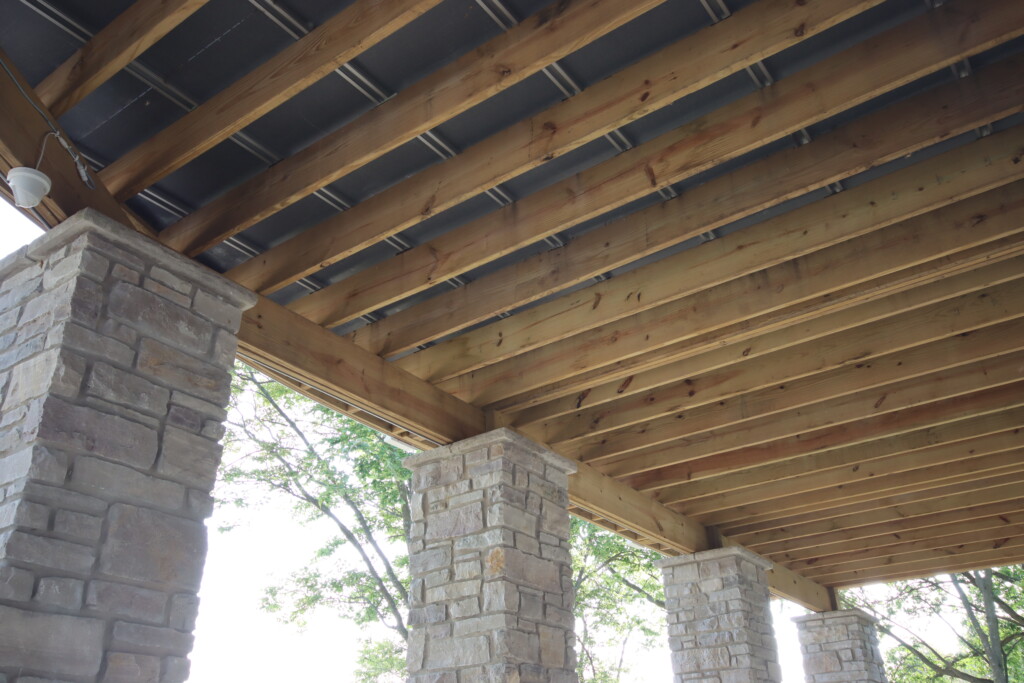
Instead, the deck surface is removed to expose the structural framing.
Protective butyl tape is installed where the aluminum support tracks contact the framing. The tracks are then mechanically fastened at their intersections with the joists. Reinforced porcelain locks with the track system to create the finished walking surface.
This changes the load path.
Rather than asking an existing wood deck board to function as a tile substrate, the porcelain decking system transfers loads through its engineered components into the deck framing.
Why Reinforced Porcelain Is Different From Conventional Tile
“Porcelain tile” can describe a broad category of materials.
The porcelain used on an elevated deck should not automatically be assumed to perform like conventional interior floor tile.
Mbrico uses reinforced porcelain pavers as part of a complete decking system. Structural reinforcement beneath the porcelain works together with the aluminum track system and mechanical connections to create an assembly intended for elevated exterior applications.
That is an important distinction when researching phrases such as “porcelain tile over wood deck.”
The solution is not simply choosing a thicker tile.
It is designing the porcelain, reinforcement, attachment system, framing interface and drainage strategy to work together.
Drainage Has to Be Part of the Design
Water management is another reason exterior porcelain should be treated differently from interior tile.
Traditional tile assemblies often depend on bonded layers, membranes, mortar and carefully detailed drainage systems.
An open-joint porcelain decking system approaches water differently.
Mbrico maintains consistent gaps between the reinforced porcelain pieces. Water can pass through the surface rather than depending on grout joints to keep water above it. The space below the finished surface remains ventilated and capable of draining.
The deck frame still requires proper flashing and water-management detailing, but the porcelain walking surface does not depend on a conventional mortar-and-grout assembly to perform outdoors.
Does a Wood Deck Need Extra Joists for Porcelain?
Not automatically.
Adding porcelain does not mean that every existing wood deck needs to be rebuilt with dramatically closer joist spacing or additional beams.
The answer depends on the system being installed and the condition and design of the existing structure.
For Mbrico, the joist-framed system is specifically designed to work with conventional code-compliant deck framing. If an existing deck structure is properly constructed and remains structurally sound, the framing can potentially be retained while the old decking is removed and replaced with the Mbrico system.
If the existing structure is deteriorated, inadequately supported or otherwise unsuitable, those issues should be corrected before installing any new decking material.
Can You Convert an Existing Wood Deck to Porcelain?
In many cases, yes.
An existing wood deck can be a candidate for conversion to reinforced porcelain without completely removing the deck structure.
The process starts by determining whether the underlying framing is worth keeping.
If the joists, beams, footings and structural connections are suitable, the existing deck boards can be removed and the new porcelain decking system installed over the remaining frame.
This creates an interesting renovation opportunity.
A homeowner may be able to move from an aging wood or composite walking surface to stone, concrete or wood-inspired porcelain finishes while retaining much of the deck structure already in place.
What About Cement Board and Traditional Tile?
Traditional tile assemblies can sometimes be engineered for exterior elevated applications, but they should not be confused with simply fastening cement board over a deck and installing tile.
Exterior tile requires much more attention to movement, drainage and waterproofing than an interior floor.
TCNA notes that its handbook contains dedicated methods for exterior roof decks and balcony decks and does not provide a general backer-board system for exterior decks. Some manufacturers may approve specialized assemblies when appropriate waterproofing and installation requirements are followed.
For homeowners primarily interested in the appearance and performance of porcelain rather than recreating a traditional tile installation outdoors, a purpose-built decking system can eliminate much of that complexity.
So, Can You Put Porcelain Tile on a Wood Deck?
Yes, but porcelain should be treated as part of a decking system, not simply as tile placed over wood boards.
For a conventional tile installation, movement, substrate preparation, waterproofing and drainage can make an exterior wood-framed deck a challenging application.
With Mbrico, the approach is different.
The existing decking is removed, the wood framing is evaluated, and an engineered aluminum track system is installed directly over suitable joists. Reinforced porcelain is then mechanically integrated with that support system to create a free-draining exterior deck surface.
In many projects, the framing does not need to become something fundamentally different.
The surface assembly does.
That distinction makes it possible to bring the durability, design flexibility and long-term appearance of porcelain to traditional joist-framed decks without requiring every project to begin with a concrete slab.
Contact Us