The Decking Market Is Outgrowing the Wood vs. Composite Debate
The Decking Market Is Outgrowing the Wood vs. Composite Debate
September 4, 2026
For decades, choosing a deck surface was framed as a straightforward decision between wood and composite decking.
Wood offered familiarity, natural character and a lower initial material cost. Composite emerged as the modern alternative, promising reduced maintenance and a longer-lasting approximation of real wood.
That comparison still matters, but it no longer represents the full decking market.
Homeowners, architects and builders are now evaluating outdoor surfaces based on heat, fire performance, stain resistance, structural stability, design flexibility and total lifecycle value. As expectations have expanded, so have the available material categories.
The question is no longer simply wood or composite.
It is now: What material and system will perform best for the way this outdoor space will actually be used?
The Quick Answer
The decking market is moving beyond the traditional wood-versus-composite debate because reduced maintenance is no longer the only priority.
Today’s buyers are also comparing:
- Surface temperature in direct sunlight
- Fire and ignition resistance
- Moisture absorption
- Stain and scratch resistance
- Structural stability
- Drainage and ventilation
- Long-term appearance
- Design flexibility
- Lifecycle cost
- Performance of the complete deck assembly
Wood and composite remain major decking categories, but they are no longer the only serious options. PVC, aluminum, concrete pavers and reinforced porcelain deck systems have expanded what a deck can look like and how it can perform.
How Wood and Composite Came to Define the Market
Traditional wood decking established the format most people still associate with a deck: individual boards fastened over joist framing.
Wood remains widely used because it is familiar, readily available and understood by most contractors. It can also provide the natural appearance many homeowners want.
Its limitations are equally familiar. Depending on the species and environment, wood may require recurring staining, sealing, sanding or board replacement. It can also split, splinter, warp, fade or deteriorate as it is exposed to moisture, sunlight and temperature changes.
Composite decking was developed to address many of those concerns while preserving the familiar deck-board format.
By combining wood fibers, plastics or other engineered materials, composite manufacturers created products that generally require less recurring maintenance than traditional lumber. Composite helped establish an important new expectation: a deck should not need constant refinishing to remain usable.
That was a major advancement, but it was not the end of decking innovation.
What Current Composite Innovation Tells Us About the Market
Some of the clearest evidence that buyer expectations are changing comes from composite and PVC manufacturers themselves.
Industry-leaders are actively working to upgrade product lines to better suit heat-mitigation, fire-resistance, and flame-spread to meet WUI compliance.
These are meaningful product developments. They also demonstrate that the market is no longer satisfied by the original composite value proposition alone.
Reduced staining and sealing are still important, but manufacturers are now competing over:
- How hot the surface becomes
- How the material responds to fire
- How realistically it reproduces natural materials
- How it performs in demanding climates
- How much recycled content it contains
- How well it retains its appearance over time
Composite is not disappearing. It is evolving because the customer’s definition of performance is evolving.
Low Maintenance Is Now the Starting Point
When composite decking first entered the market, reduced maintenance was a powerful differentiator.
Today, many buyers consider it a baseline expectation.
Homeowners investing in outdoor kitchens, lounge areas, pool surrounds and other permanent exterior improvements are not only asking whether a deck needs to be stained. They are considering whether it will be comfortable in direct sunlight, resist spills, accommodate heavy furniture and continue complementing the architecture years after installation.
Commercial buyers face an even longer list of requirements. Rooftop terraces, balconies, hospitality spaces and multifamily amenity decks must account for frequent use, drainage, fire performance, accessibility, furniture loads and long-term maintenance.
That changes the evaluation from a simple material comparison into a system-level decision.
Porcelain Introduces a Different Decking Category
Porcelain does not begin with a deck board and attempt to improve it.
It begins with a dense, kiln-fired architectural surface that is naturally resistant to water absorption, staining, scratching and UV-related color changes. Porcelain can reproduce the appearance of natural stone, concrete, wood and other materials without requiring the maintenance associated with many of those surfaces.
Historically, porcelain tile was associated with installation over concrete using mortar, adhesives and grout. Exterior porcelain pavers later expanded its use to patios and pedestal-supported rooftops.
Reinforced porcelain deck systems take the material one step further.
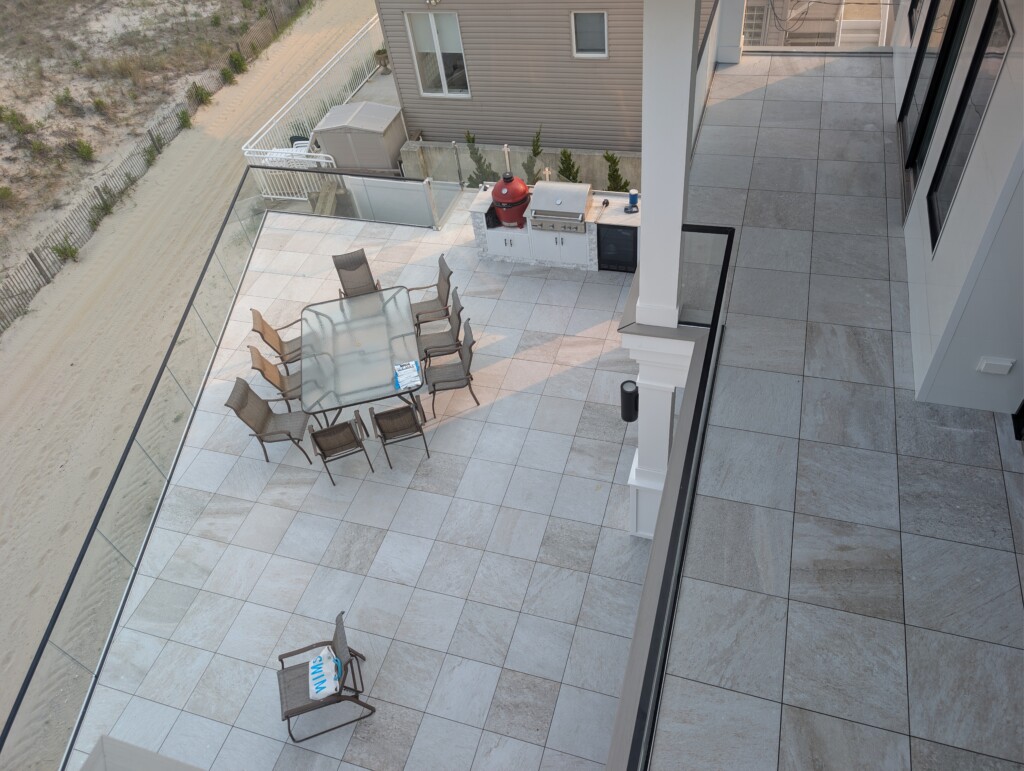
They integrate porcelain into a purpose-built assembly that can be used over conventional deck framing, rooftop pedestals and low-profile support systems. This allows porcelain to function as an actual decking surface rather than simply decorative tile installed outdoors.
Not Every Porcelain Paver Is a Deck System
The distinction between a surface material and a complete deck system is important.
A porcelain paver may offer excellent surface properties, but the finished deck must still address:
- Structural support
- Point loading
- Lateral movement
- Mechanical attachment
- Drainage
- Ventilation
- Wind uplift
- Consistent spacing
- Access beneath the surface
Loose-laid pavers and independently sourced components may not perform as a unified assembly.
That is why architects, builders and homeowners should evaluate how the entire system works, not just what the finished surface is made from.
How Mbrico Approaches Modern Decking
Mbrico reinforced porcelain deck systems combine exterior-grade porcelain with structural reinforcement, aluminum support tracks and mechanical fastening.
Depending on the application, Mbrico can be installed over joist framing, adjustable rooftop pedestals or a low-profile ventilated support system.
This system-based approach provides:
- A non-porous porcelain walking surface
- No recurring staining or sealing
- Structural reinforcement beneath each elevated tile
- Mechanically connected system components
- Open joints for drainage and ventilation
- Resistance to fading, staining and freeze-thaw exposure
- Broad stone, concrete and wood-look design options
- Solutions for decks, balconies, patios and rooftops
Mbrico is therefore not simply another material competing for a place within the wood-versus-composite comparison.
It represents a different way to construct an outdoor surface.
Which Decking Category Is Right for Your Project?
Wood can remain appropriate when natural material, familiarity and lower initial cost are the primary considerations and the owner accepts ongoing maintenance.
Composite and PVC can be good options when a familiar plank appearance and reduced maintenance are the leading priorities.
Concrete or loose porcelain pavers may fit ground-level hardscapes and certain pedestal-supported applications.
Reinforced porcelain deck systems should be considered when the project prioritizes architectural appearance, surface durability, structural integration, low maintenance and performance across elevated or demanding exterior applications.
The correct choice depends on the project. The important change is that buyers now have more than two credible categories to evaluate.
The Decking Conversation Has Changed
The decking market is not abandoning wood or composite.
It is outgrowing the assumption that every outdoor project must begin and end with those two choices.
As outdoor spaces become more permanent, more valuable and more heavily used, buyers are asking materials to do more. They want surfaces that are comfortable, durable, attractive and appropriate for the conditions in which they will be installed.
That broader performance standard is creating room for a new generation of engineered deck systems.
For homeowners, architects and builders evaluating an upcoming project, the better question is no longer:
Wood or composite?
It is:
Which complete decking system best supports the design, performance and lifespan this project requires?
Explore Mbrico reinforced porcelain deck systems or contact Mbrico for samples, technical information and project-specific assistance.
Contact Us