
What Are the Problems With Pedestal Paver Systems?
What Are the Problems With Pedestal Paver Systems?
April 16, 2026
Rooftop decks and elevated surfaces demand more than aesthetics. They require structural stability, long-term performance, and predictable behavior under real-world conditions.
Pedestal paver systems are commonly used in these applications. They are simple in concept. Pavers are supported at the corners by adjustable pedestals, creating a floating surface over a roof or substrate.
While widely specified, pedestal systems introduce a series of performance limitations that are often overlooked during design.
This article breaks down the most common problems with pedestal pavers, based on how they perform over time.
Movement and Instability
Pedestal systems are not mechanically fastened. Each paver rests loosely on four points of contact.
This creates inherent movement.
Under foot traffic, furniture loads, or environmental forces, pavers can:
- Shift laterally
- Rock or teeter under load
- Produce noise during use
Even when installed correctly, this is not a rigid system. It is a floating surface.
On high-end projects or commercial rooftops, this lack of stability becomes noticeable quickly.
Read More: What is the Best Decking System? Performance Guide
Point-Load Limitations
Pedestal systems support weight at the corners of each tile.
This creates concentrated point loads rather than distributed structural support.
Implications include:
- Increased stress at pedestal contact points
- Higher risk of cracking under heavy or dynamic loads
- Limitations for applications with furniture, planters, or high foot traffic
While porcelain itself may be strong, the way it is supported in pedestal systems reduces its effective performance.
Wind Uplift Vulnerability
One of the most critical issues with pedestal pavers is wind uplift.
Because tiles are not mechanically secured:
- Wind can get beneath the system
- Individual pavers can lift or shift
- Entire sections can become unstable in high-wind environments
This is especially relevant for:
- High-rise rooftops
- Coastal regions
- Open commercial structures
Many pedestal systems rely on weight alone to resist uplift, which introduces risk in exposed conditions.
Read More: What Is Wind Uplift & How it’s Calculated for Rooftop Pavers

Brigantine Marina & Paddle Club | Brigantine, NJ
Long-Term Maintenance Challenges
One of the hidden realities of pedestal systems is what happens after installation.
To access the substrate below:
- Pavers must be lifted individually
- Layout alignment can be disrupted
- Pedestals may shift during reinstallation
Over time, this leads to:
- Uneven surfaces
- Increased labor for maintenance
- Progressive performance degradation
What begins as a simple install can become a recurring maintenance cycle.
Read More: Why Mbrico Tile Decks Last Longer Than Traditional Decking Systems
Surface vs System Disconnect
Perhaps the most important issue is how pedestal systems are specified.
In many cases, the focus is placed on the surface material:
- Porcelain
- Concrete
- Stone
But the performance of the deck is dictated by the system, not just the surface.
Pedestal systems treat the surface and structure as separate components.
This disconnect leads to:
- Inconsistent performance
- Lack of structural integration
- Reduced long-term reliability
Read More: Mbrico vs Tile Tech
Where Pedestal Systems Fall Short
Pedestal pavers can work in certain low-demand applications.
But in more demanding environments, their limitations become clear:
- Rooftop decks over conditioned space
- High-traffic commercial areas
- Freeze-thaw climates
- Wind-exposed structures
In these cases, performance is not just about installation. It is about how the system behaves over decades.
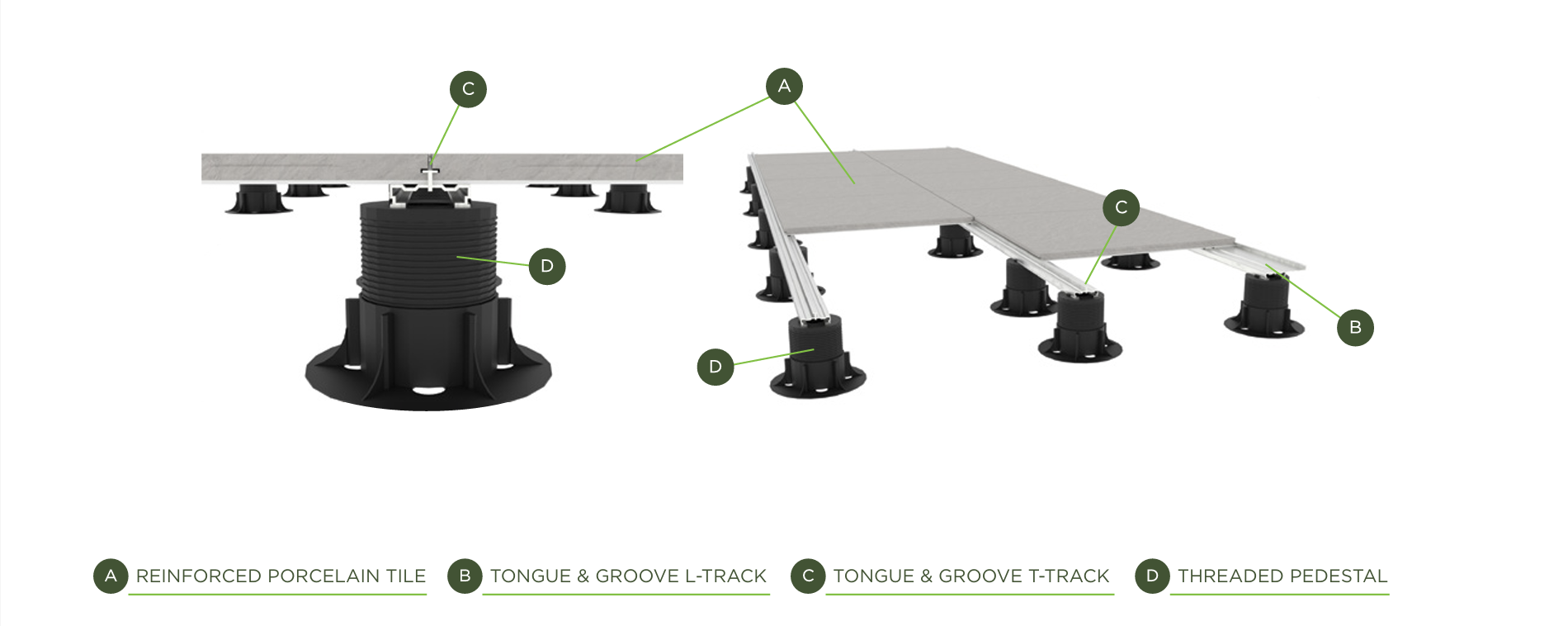
Rooftop & Pedestal System Detail | Mbrico
The Shift Toward Integrated Systems
As performance expectations increase, the industry is moving toward systems that:
- Mechanically secure the surface
- Distribute loads more effectively
- Eliminate movement
- Address wind uplift directly
This represents a shift from floating surfaces to engineered deck systems.
Final Takeaway
Pedestal paver systems are simple, but simplicity does not equal performance.
Their core limitations come from:
- Lack of mechanical connection
- Point-load support structure
- Vulnerability to movement and wind
- Dependence on maintenance over time
For projects where long-term reliability matters, these factors should be evaluated early in the design process.
Because in elevated and rooftop applications, the system beneath the surface is what ultimately determines success.
Contact Us