
Wind Uplift Requirements for Rooftop Decks
Wind Uplift Requirements for Rooftop Decks
April 20, 2026
What architects, engineers, and builders need to know before specifying a system
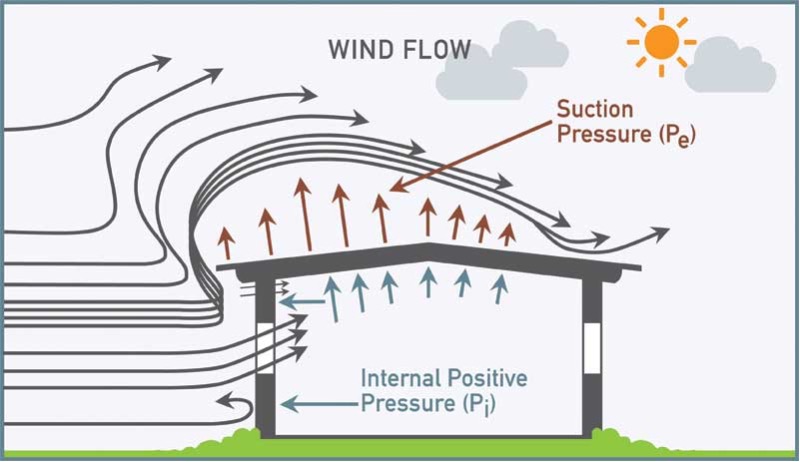
Rooftop decks are not just exposed to weather. They are subjected to uplift forces that can exceed the weight of the deck itself. When wind moves across a roof surface, it creates negative pressure that can literally pull materials upward.
If your decking system is not engineered for wind uplift, failure is not a possibility.
What is Wind Uplift?
Wind uplift occurs when high-speed air passes over a building and reduces pressure on the roof surface. This creates suction that attempts to lift materials off the structure.
Three critical zones define how severe uplift becomes:
- Field (center of roof): Lowest uplift forces
- Perimeter (edges): Moderate uplift forces
- Corners: Highest uplift forces, often 2–3x the field pressure
Most rooftop deck failures begin at the edges or corners, not the center.
Why Rooftop Decking Systems Fail Under Wind
Many rooftop deck systems are not actually designed for wind uplift. They rely on gravity alone.
Common failure points include:
- Loose-laid pedestal pavers shifting or lifting
- Tiles sliding due to vibration and pressure changes
- Edge pieces becoming airborne first, triggering chain failure
- No mechanical attachment to the structure
This is especially dangerous in:
- High-rise buildings
- Coastal regions
- Open rooftop amenity spaces
- Areas with frequent storm activity
Key Wind Uplift Standards and Testing
To properly evaluate a rooftop decking system, you need to look at certified testing standards, not assumptions.
Miami-Dade County NOA (Notice of Acceptance)
- Considered the gold standard for wind resistance
- Required in High Velocity Hurricane Zones (HVHZ)
- Verifies performance under extreme uplift conditions
Florida International University Wall of Wind Testing
- Full-scale structural testing facility
- Simulates hurricane-force winds (up to 160+ mph)
- Evaluates real system performance, not just components
American Society of Civil Engineers ASCE 7
- Defines wind load calculations for buildings
- Used by engineers to determine required uplift resistance
Factory Mutual Global Ratings
- Insurance-driven performance standards
- Often required for commercial and industrial projects

What a Compliant Rooftop Deck System Must Do
To meet real-world wind uplift requirements, a system must go beyond surface-level solutions.
At minimum, it should:
- Be mechanically attached to the structure
- Be tested as a complete system, not individual parts
- Provide resistance across field, perimeter, and corner zones
- Prevent lateral movement and vibration
- Maintain performance after repeated wind exposure
Anything less introduces risk.
Read More: Why Rooftop Decks Fail
The Difference Beteween Surface Systems and Engineered Systems
There are two fundamentally different approaches to rooftop decking.
Surface-Based Systems (High Risk)
- Loose-laid pavers on pedestals
- No structural attachment
- Depend entirely on weight
- Vulnerable at edges and corners
Engineered Systems (Wind-Resistant)
- Mechanically fastened to structure
- Integrated track or support system
- Designed to resist uplift forces
- Tested under real wind conditions
This distinction is where most specification mistakes happen.
Why Wind Uplift Matters More in 2026 and Beyond
Modern buildings are:
- Taller
- Lighter
- More open at rooftop level
- Designed with larger amenity decks
At the same time, weather patterns are becoming more volatile.
This combination increases uplift exposure significantly.
Ignoring wind uplift is no longer a minor oversight. It is a liability issue.
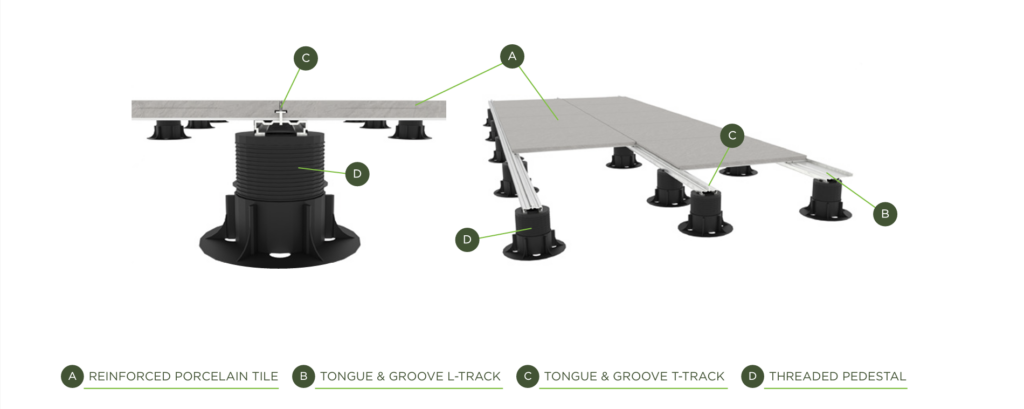
Rooftop & Pedestal System Detail | Mbrico
Specification Checklist for Architects
Before approving any rooftop decking system, confirm:
- Does it have a Miami-Dade NOA or equivalent certification?
- Has it been tested at a facility like FIU’s Wall of Wind?
- Is the system mechanically fastened, not just weighted?
- Are uplift values provided for corner and perimeter zones?
- Is the system approved for your specific building height and exposure category?
If any of these answers are unclear, the system is not fully vetted.
Read More: Why Architects Love Mbrico
Final Takeaway
Wind uplift is one of the most misunderstood forces in rooftop construction.
Most failures are not caused by material weakness. They are caused by systems that were never designed to resist uplift in the first place.
When specifying a rooftop deck, the question is not:
“What looks good?”
It is:
“What stays in place when everything else is trying to pull it off the building?”
Contact Us