
Load Rating Requirements for Elevated Deck Systems
Load Rating Requirements for Elevated Deck Systems
April 21, 2026
What engineers, architects, and builders need to know
Elevated deck systems are not just surface finishes.
They are structural assemblies that must safely support people, furniture, equipment, and environmental loads over time.
And yet, many systems used today are not engineered with long-term load performance in mind.
Understanding load rating requirements is critical to preventing deflection, movement, and structural failure.
What is a load rating for an elevated deck system?
Load rating defines how much weight a deck system can safely support without failure.
This includes:
- Dead Load
The weight of the system itself including framing, surface material, pedestals, and accessories - Live Load
The weight of people, furniture, planters, and movable objects - Environmental Load
Snow, wind uplift forces, and in some cases seismic activity
Typical load requirements (IRC standards)
Most elevated decks are designed in accordance with the International Residential Code.
Common requirements include:
- Residential decks:
40 pounds per square foot (psf) live load - Commercial decks:
100 psf live load or greater depending on occupancy - Assembly spaces (rooftop amenities, hospitality):
100–150 psf or higher
These are minimums. Not performance benchmarks.
Why minimum load ratings are not enough
Meeting code does not mean the system performs well.
Many traditional systems technically meet load requirements but still experience:
- Surface deflection under normal use
- Movement between components
- Long-term structural fatigue
- Failure at connection points
This is especially common with:
- Floating pedestal paver systems
- Mechanically unfastened assemblies
- Systems with multiple independent components
Read More: Why Mbrico Lasts Longer Than Than Traditional Decking Systems

Hunting Lodge | Iowa
Point load vs distributed load
Not all loads are evenly distributed.
Elevated decks must also handle point loads, including:
- High heels
- Furniture legs
- Planters
- Grills and equipment
Systems that lack structural integration often fail here first.
This is where wobble, cracking, and breakage begin.
Deflection limits matter
Load rating is not just about failure. It is about performance.
Excessive deflection leads to:
- Perceptible movement underfoot
- Long-term system fatigue
- Water drainage issues
- Safety concerns in commercial environments
Engineered systems are designed to minimize deflection, not just prevent collapse.
The role of system design
The biggest variable in load performance is not the surface material.
It is the system.
Key factors include:
- Mechanical fastening vs floating placement
- Load transfer across the entire assembly
- Integration between surface and structure
- Support spacing and substructure design
Most pedestal systems isolate each paver.
Engineered systems distribute load across the entire surface.
That difference defines long-term performance.
Read More: Why Deck Builders Love Mbrico
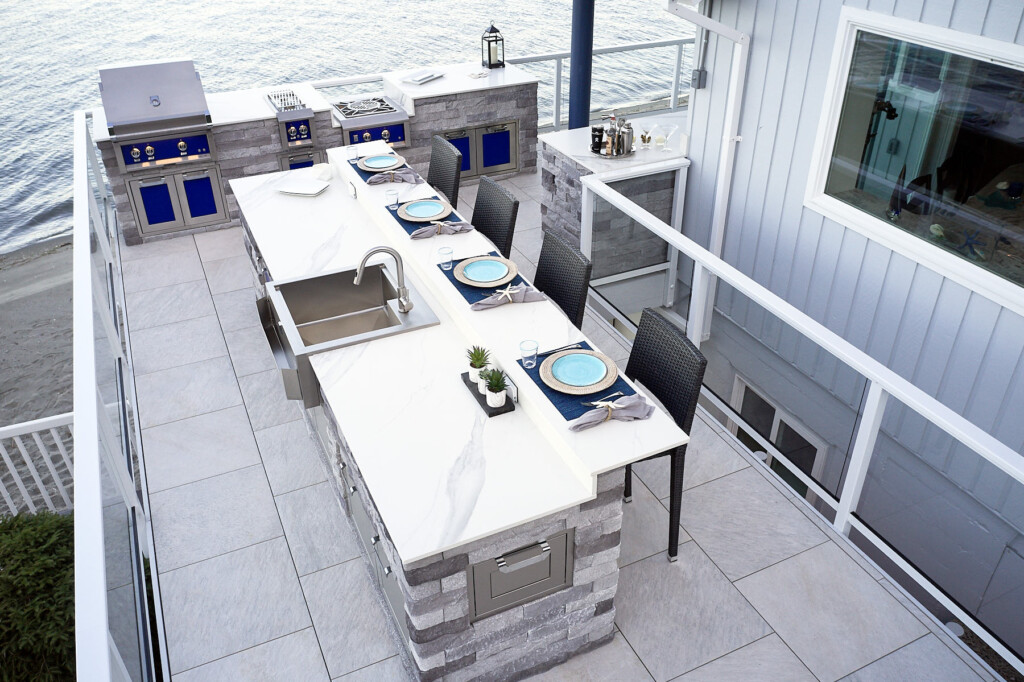
Custom Outdoor Kitchen | Seattle, WA
Where many elevated systems fall short
Common failure points include:
- Pedestals shifting under dynamic loads
- Pavers cracking under point loads
- Uneven weight distribution
- Lack of lateral stability
These are not theoretical risks.
They are common field failures.
Performance snapshot: engineered vs floating systems
Floating pedestal systems:
- Meet minimum load ratings
- Limited resistance to movement
- High reliance on perfect installation
- Vulnerable to point load stress
Engineered deck systems:
- Designed for structural load distribution
- Mechanically integrated components
- Reduced deflection and movement
- Consistent performance over time
How Mbrico addresses load rating requirements
Mbrico Tile Decks are engineered as a complete system, not a collection of parts.
Key performance characteristics:
- Up to 4,500 lb load capacity per tile
- Mechanical fastening to structural framing
- Load distributed across interconnected system
- No independent movement between components
- Designed for rooftop, balcony, and elevated applications
This results in:
- Zero perceptible wobble
- High resistance to point load failure
- Long-term structural stability
Read More: Mbrico vs Composite Decking
Why this matters for rooftop and elevated applications
Elevated decks are exposed to:
- Constant load cycling
- Environmental stress
- High-traffic usage
Systems that only meet minimum code requirements often degrade quickly.
Systems engineered for load performance do not.
Read More: What is the Best Rooftop Decking System?
Final takeaway
Load rating is not just about passing inspection.
It is about how a system performs every day for decades.
If the system allows movement, isolates components, or relies on gravity alone, it will eventually fail under real-world conditions.
If the system is engineered to distribute load, integrate structurally, and resist deflection, it performs.
Contact Us