ADA Compliance for Rooftop Decking Systems
ADA Compliance for Rooftop Decking Systems
April 28, 2026
ADA Compliance for Rooftop Decking Systems
Accessibility is no longer optional in modern construction.
For rooftop decks, balconies, and elevated amenity spaces, ADA compliance is a baseline requirement. Not just for code. For safety, usability, and long-term performance.
The challenge is that most decking materials were never engineered with accessibility in mind.
They are adapted to meet requirements, not designed for them.
That creates risk.
This guide breaks down what ADA compliance actually requires for rooftop decking systems and how to ensure your project meets those standards without compromise.
What Does ADA Compliance Mean for Rooftop Decking?
ADA compliance refers to the standards set by the Americans with Disabilities Act to ensure spaces are accessible to individuals with disabilities.
For rooftop decking systems, this primarily impacts:
- Slip resistance
- Surface stability
- Level transitions
- Drainage integration
- Overall usability under real-world conditions
It is not just about checking a box.
It is about how the system performs over time.
Read More: Why Rooftop Decks Fail
Slip Resistance Requirements (DCOF)
Slip resistance is one of the most critical components of ADA compliance.
The standard used across the industry is Dynamic Coefficient of Friction (DCOF).
For exterior walking surfaces:
- A DCOF of 0.42 or higher is generally required
- Surfaces must maintain traction when wet
- Performance must be consistent across the entire deck
Most traditional decking materials struggle here.
Wood becomes slick when wet.
Composites often lose traction over time.
A compliant system must deliver both traction and consistency.
Mbrico porcelain paver & rooftop pedestal system is engineered with high DCOF ratings that maintain traction in wet conditions, helping meet ADA expectations without added treatments or coatings.
Surface Stability Matters Just as Much as Traction
ADA compliance is not just about friction.
It is also about how the surface behaves under load.
Key requirements include:
- No vertical movement or deflection
- No rocking or wobble between components
- Consistent elevation across the walking surface
This is where many rooftop systems fail.
Floating assemblies and pedestal systems inherently allow movement. Even slight shifts can create instability underfoot, especially for individuals using mobility devices.
Mbrico’s mechanically fastened track system eliminates that movement, creating a stable, uniform surface designed for long-term accessibility.
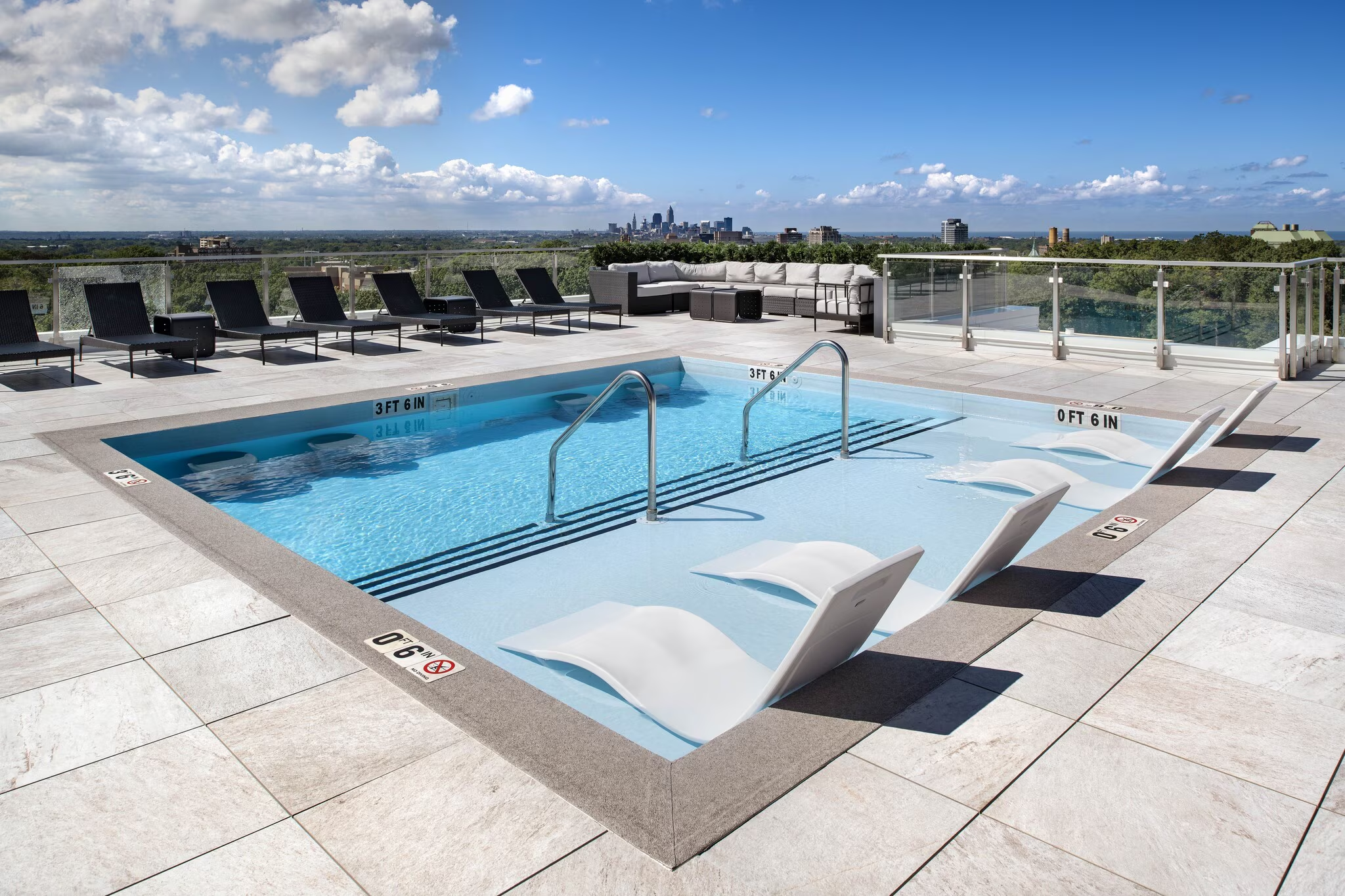
The Ascent, Top of the Hill | Cleveland Heights, Ohio
Drainage Without Compromise
Rooftop decks must manage water effectively.
But drainage design often conflicts with accessibility.
Common issues include:
- Gaps between pavers
- Uneven spacing
- Water pooling
- Surface inconsistencies
An ADA-compliant system must:
- Drain efficiently
- Maintain a uniform walking surface
- Prevent trip hazards
Mbrico systems are designed to be free-draining while maintaining consistent spacing and alignment, avoiding the surface inconsistencies common in pedestal-based assemblies.
Level Transitions and Edge Conditions
Transitions between surfaces are a major compliance factor.
ADA guidelines require:
- Minimal height differences between adjacent surfaces
- Smooth transitions at door thresholds
- No abrupt elevation changes
This becomes especially important on rooftop decks multiple systems meet.
Because Mbrico is a fully engineered system, transitions can be planned and executed with precision, reducing risk at thresholds and edges.
Where Most Rooftop Decking Systems Fall Short
Many rooftop decking solutions on the market today were not engineered systems.
They are assemblies of components.
That leads to:
- Inconsistent surface alignment
- Long-term movement and settling
- Reduced traction over time
- Increased risk of non-compliance
These issues are not always visible on day one.
They develop over time.
Read More: What is the Best Rooftop Decking System?
Performance Snapshot: ADA-Compliant Decking System
A system designed for ADA compliance should deliver:
- DCOF ≥ 0.42 for wet conditions
- Zero surface movement under load
- Uniform spacing and alignment
- Integrated drainage without surface disruption
- Stable, consistent walking surface over time
Mbrico systems are engineered to meet each of these criteria, not as add-ons, but as core design features.
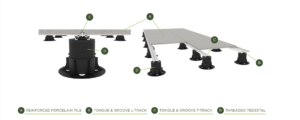
Rooftop & Pedestal System Detail | Mbrico
Why Engineered Systems Matter
The difference between compliance and long-term performance comes down to system design.
Engineered decking systems are built to:
- Eliminate movement between components
- Maintain consistent spacing and alignment
- Deliver reliable traction across all conditions
- Integrate drainage without compromising usability
This is not something that can be added later.
It must be built into the system from the start.
ADA Compliance Is About Long-Term Performance
A rooftop deck can meet ADA requirements on installation day and still fail over time.
That is the reality with many traditional systems.
Mbrico is designed to maintain its performance over decades, helping ensure accessibility is not just achieved, but sustained.
Final Takeaway
ADA compliance for rooftop decking is not just about meeting minimum standards.
It is about delivering a surface that remains safe, stable, and usable for the life of the structure.
Most decking materials were not designed for this.
Mbrico was.
Contact Us